Organised by:
Geological Society Events
Venue:
The Geological Society, Burlington House, London
Event status:
EVENT CLOSED
The extinct dwarf elephants of the Mediterranean are remarkable. They evolved many times, on many islands, from large mainland species such as the 4-metre tall straight-tusked elephant. Some of these dwarf elephant species were just 1-metre tall as adults, making them the smallest elephants to have ever existed. But although we know that dwarf elephants evolved in response to the island environment, we still don’t fully understand the causes. A big part of this problem is that we simply do not know how old these elephant fossils are: some of the best fossil evidence was collected over 100 years ago, before modern geological dating techniques were available.
To change this, I’ve been seeking out sites excavated by Victorian and Edwardian naturalists such as Thomas Spratt, Andrew Leith Adams, Hugh Falconer and Dorothea Bate, so that we could bring modern methods to bear on their discoveries. In this talk, I will tell the story of those pioneering researchers, and how I came to follow in their footsteps with a team of geochronologists, and what our new findings might mean for our understanding of dwarf elephant evolution.
Speaker
Victoria Herridge (Natural History Museum)
Biography
Victoria Herridge’s PhD (Evolutionary Biology, University College London) investigated the evolution of dwarf elephants, and highlighted the need for accurate and reliable dating of Mediterranean island fossils. This led directly to her NERC-funded post-doctoral research at the Natural History Museum, where she co-led an international team of experts on a new fieldwork initiative in the Mediterranean. This project focused on dating important dwarf elephant and dwarf deer fossil localities, to enable the evolution of these species to be understood against the backdrop of the major environmental changes of the Pleistocene.
Victoria is an award winning science communicator – she delivered the 2012 Charles Lyell Award lecture at the British Science Festival, and co-wrote and appeared in the Natural History Museum’s acclaimed interactive film Who Do You Think You Really Are (Premier Award Winner, Learning on Screen 2011).
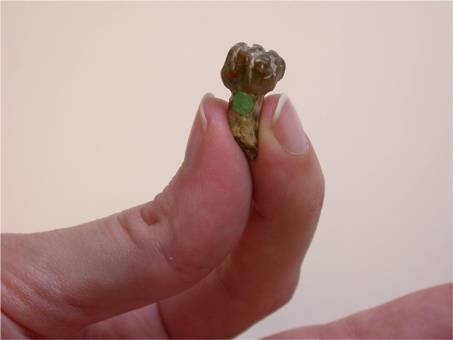
Image: Baby dwarf elephant tooth from Malta (collected by Rear-Admiral TAB Spratt in the 19th Century)
Photo credit: Victoria Herridge; copyright: Natural History Museum, London