
The Geological Society of London is the world's oldest geological society. Since its foundation in 1807 it has developed into the UK national professional body for geoscientists.
The Society provides a wide range of professional and scientific support to its c.12,000 Fellows, about 2000 of whom live overseas. As well as boasting one of the most important geological libraries in the world, the Geological Society is a global leader in Earth science publishing, and is renowned for its cutting edge science meetings. It is a vital forum in which Earth scientists from a broad spectrum of disciplines and environments can exchange ideas, and is an important communicator of geoscience to government, media, those in education and the broader public.
Below is a brief guide to the Society's history.
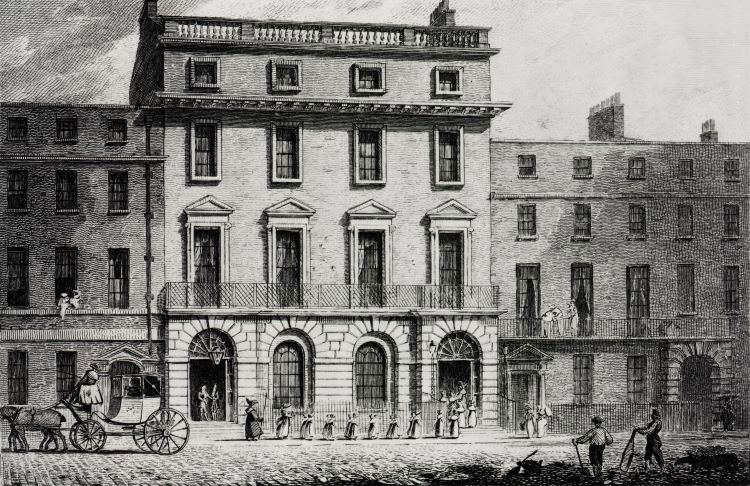
Freemason's Tavern in Covent Garden, c.1800. Engraved by S Rawle for the European Magazine after the original by John Nixon. (Archive ref: GSL/ARC/3/4 - CP90/32)
The Geological Society has its origins in a series of meetings convened at the beginning of 1807 by four amateur mineral enthusiasts - physician William Babington (1756-1833), pharmaceutical chemist William Allen (1770-1843), and the Quaker brothers William (1773-1828) and Richard Phillips (1778-1851).
Their aim was to organize the publication of a monograph on mineralogy by Jacques-Louis, Comte de Bournon (1751-1825) who was an émigré from the French Revolution. The group, along with ten other friends who were also active in London's flourishing scientific scene, resolved to each contribute the sum of £50 to cover the cost of the monograph's publication – issued in three volumes in 1808 as 'Traité complet de la Chaux Carbonatée et de l'Arragonite'.
Having enjoyed the meetings so much, many of the group continued to hold mineralogical discussions at Babington's house in Aldermanbury, London, usually at 7am before the physician began his rounds at Guy's Hospital. Other interested parties also joined the meetings and on the 13 November 1807, the new society was inaugurated at a dinner at the Freemasons Tavern, Great Queen Street, Covent Garden (the meetings being moved from breakfast to dinner time at the suggestion of Humphry Davy).
The minutes of the meeting recorded the thirteen founder members:

Arthur Aikin (1773-1854)

William Allen (1770-1843)

William Babington (1756-1833)

Humphry Davy (1778-1829)

Comte Jacques-Louis de Bournon (1751-1825)
James Franck (1768-1843)

George Bellas Greenough (1778-1855)

Richard Knight (1768-1844)
James Laird (1779-1841)
James Parkinson (1755-1824)

William Haseldine Pepys (1775-1856)

Richard Phillips (1778-1851)

William Phillips (1773-1828)
The meeting resolved
'That there be forthwith instituted a Geological Society for the purpose of making geologists acquainted with each other, of stimulating their zeal, of inducing them to adopt one nomenclature, of facilitating the communications of new facts and of ascertaining what is known in their science and what remains to be discovered.'
These aims were incorporated in the first constitution of the Society, formally adopted at a meeting on 1 January 1808.
The new Society was to meet over dinner at the Freemason’s Tavern on the first Friday of every month. Dinner was to be on the table at 5pm precisely at a cost of 15 shillings per head (c.£60 in today’s money).
Once the Society acquired its own premises there was an attempt to continue the dining-based meetings but interest in them diminished. In 1824 they were resurrected with the formation of the Geological Society Club. It is still in existence, now called the ‘Discussion Group’.
Further reading
- Woodward, H B, The history of the Geological Society of London. London: Geological Society (1907)
- Herries Davies, G L, Whatever is under the Earth: the Geological Society of London 1807 to 2007. London: Geological Society (2007)
- Gray, David A, ‘A review of the archives of the Geological Society Club’, October 1995 (Archive ref: GSL/GD/13/5)
To achieve the aims set out at the first meeting, the Society distributed a pamphlet called ‘Geological Inquiries’ in the early spring of 1808. The contents were a call to the general public to send in information on what was known about the geology and mineralogy of Britain. The specimens, books and diagrams which were received became the basis of the Museum and library collections.
MAPPING
As the specimens and data poured in as a result of 'Geological Inquiries', what became clear was that there was very little in the way of geological maps of Britain. Therefore in April 1809 a Committee of Maps was formed to oversee
“...the construction of Mineralogical Maps and the collection of Drawings, Models, Sections of Mines, &c, are well worthy the attention of the Geological Society, and cannot fail materially to promote the objects which they had in view of associating.”
(Ordinary Minutes of the Geological Society of London, 7 April 1809, GSL/OM/1/1).

Louis Albert Necker’s geological map of Scotland, which was presented at the Ordinary Meeting of the Geological Society, 4 November 1808. (Archive ref: LDGSL/701)
As well as being the earliest geological map of Scotland, it was one of the few maps which were presented to the Society in the first few years.
In July 1810, Members were informed of the Society’s ambitious plan to create its own geological map of the country. The original idea was that Members of the Society living in the various regions of the country would colour in parts of a map for collation, but this singularly failed to work. Instead the first President of the Society, George Bellas Greenough who was not a member of the Committee of Maps, decided to draft his own version in 1812. This was adopted by the Society and eventually published in 1820.
The map would prove controversial due to accusations that it plagiarised William Smith’s (1769-1839) map ‘A Delineation of the Strata of England and Wales and part of Scotland…’ (1815). Smith was known to have been working on it from at least 1800 and it was published nearly five years before the Society’s version.

The Society's 'Geological Map of England and Wales' (1820). (Archive ref: LDGSL/979A/1)

William Smith's 'A Delineation of the Strata of England and Wales...' (1815). (Archive ref: LDGSL/22)

Sir Joseph Banks, 1810. (GSL/POR/56/8)
The eminent naturalist and President of the Royal Society Sir Joseph Banks (1743-1820) joined the Geological Society as an Ordinary Member on 1 January 1808. Yet just over a year later his resignation was reluctantly accepted at the meeting of 3 March 1809. Banks’ reason was that he believed the Society had deviated from its original remit of a scientific supper club. That the Society was about to move into its first premises and was considering publishing its own papers was, as Banks saw it, trespassing on the territory of the Royal Society.
A Special General Meeting (SGM) was called for 10 March 1809 at the Freemason’s Tavern to consider the proposal by the Rt Hon Charles Greville (1749-1809) that the Geological Society be an ‘Assistant Society’ to the Royal Society. Under the proposal Fellows of the Royal Society would have senior status in the Geological Society’s membership and run its Council and committees. All scientific communications would be sent to the Royal Society which would select the best to be published within its Philosophical Transactions. The papers which the Royal Society rejected would then be returned to the Geological Society, which it could publish if it wanted.
At the SGM the proposal was rejected and Greville, along with Society founder Humphry Davy, resigned on 7 April 1809. The rebuff was not acrimonious as Davy would rejoin as a Member in June 1815 and Sir Joseph Banks continued to send the Society specimens and publications.

Charles Greville, 1810. (GSL/POR/56/54)
The early meetings were held at the Freemason’s Tavern in Covent Garden but once the Society began to acquire collections of books and specimens, these needed somewhere to be stored to make them accessible to Members. Additionally the Society also wanted a more permanent place to hold its meetings.

Locations of the premises of the Geological Society, marked on John Cary's 'New pocket Plan of London, Westminster and Southwark (1819). (Source: Bibliothèque nationale de France, GED-187).
1. Freemason's Tavern, Great Queen Street, 1807-1810. Original building no longer extant.
2. Garden Court, 1809-1810. Original building demolished in 1884.
3. Lincoln's Inn, 1810-1816. Original building demolished in the late 19th century.
4. Bedford Street, 1816-1828. Building still extant but much changed.
5. Somerset House, 1828-1874.
6. Burlington House, 1874 to present.
GARDEN COURT AND LINCOLN’S INN
At the end of 1808, it was decided to look into the possibility of acquiring premises and in March 1809 it was reported that rooms on the ground floor of 4 Garden Court, Temple had been taken with a Mrs Payne (and her son) in residence to look after them. The rest of the building was occupied by the Medical & Chirurgical Society (an organisation also founded by William Babington). However the space was too small to accommodate the meetings of the Society which continued to be held at the Freemason’s Tavern. Therefore in April 1810 the two societies leased a larger building at the more prestigious address of 3 Lincoln's Inn Fields. The Medical & Chirurgical Society had the front room on the ground floor, the Society exclusive use of the second floor and the two shared the first floor to hold their respective meetings. The Society’s first meeting was held there on 1 June 1810.
BEDFORD STREET
The continual growth of the collections necessitated a further move in June 1816 to 20 Bedford Street, Covent Garden but this time the Society leased the entire building on its own. On the ground floor was a shop, so the Society’s main rooms were on the upper floors. The staircase of the building was rather narrow and famously caused William Daniel Conybeare (1787-1857) problems when he spent all day of the 20 February 1824 fruitlessly trying to manoeuvre the three-metre-long fossil of Plesiosaurus dolichideirus found by Mary Anning up to the Meeting Room. Additionally there was a clay pipe factory nearby and depending on the wind direction, the clerk would complain that acrid smoke would blow into the windows.

Lithograph of the large fossil of Plesiosaurus dolichideirus found by Mary Anning. From: W D Conybeare, "On the Discovery of an almost perfect Skeleton of the Plesiosaurus", Transactions of the Geological Society of London S2-1 (1824).
SOMERSET HOUSE
Despite the early dispute with the Royal Society, many of the senior figures in the Geological Society were members of both institutions and relations remained friendly. In March 1827 the Geological Society heard that there might be rooms available at Somerset House which were currently occupied in part by the Royal Society. Following a formal petition to the Government, the Society was officially granted the rooms which had been the old Lottery Office (state lotteries had become illegal in 1826).
The Society's apartments were fitted out to designs of Decimus Burton, architect of the Temperate House at Kew Gardens and Fellow of the Geological Society. The refurbishment of the Meeting Room took longer than expected so the first meeting was not held at Somerset House until 5 December 1828. The Meeting Room was on the ground floor with the Museum on the floor above, but the collections continued to grow and the Society soon began to ask for additional space. In April 1834, the Society was granted more rooms which allowed it to expand the Museum and move the Meeting Room to the first floor – again to the designs of Decimus Burton.
Despite complaints that the new-fangled gas fittings were making the rooms too hot, resulting in the switch back to candlelight between 1832-1852, the Society’s tenure at Somerset House was in the most part happy.

Courtyard of Somerset House. On the left in front of the gateway is the former Lottery Office which became the Society's apartments in 1828. Photograph by Wendy Cawthorne, May 2004.
BURLINGTON HOUSE
Alongside the Geological Society in Somerset House were the Royal Society, the Royal Academy (which moved to Trafalgar Square in 1837) and the Society of Antiquaries. By the 1850s the Government was keen to move all the Societies out to provide accommodation for their own civil servants.
The solution was to purchase Burlington House and redevelop the site. The Royal Society alongside the Linnean and Chemical Societies moved into the main Palladian mansion (now the Royal Academy’s building) in 1857. In the west wing a hall was constructed for the three societies to use as their meeting room but also to hold examinations for the University of London.
Despite pleas to the Government, the Geological Society was not invited to join them. Therefore to make itself more visible, the Society began to hold its scientific meetings at Burlington House from May 1860.
One of the principal reasons for the Geological Society’s enthusiasm for the move was that the first few Ordinary Meetings of a new session would be well attended but then would gradually decline throughout the year. Many of the Fellows (and potential Fellows) lived near that part of town so the idea was they might turn up more often if it was closer by.

'New Burlington House', engraved by G Greatbach, showing the front of the wings constructed to house the scientific societies, in 1873 (Archive ref: LDGSL/49). The Geological Society still occupies the part on the right side of the main entrance arch.
The bother of transporting the specimens by cart across town, as well as issues with audibility in such a large and echoey room (curtains apparently improved this) led to the Society abandoning this part of its campaign in February 1863. In 1866 the Society was finally invited to be part of the Burlington House complex, in keeping with the original concept to create closer relationships between art and science.
The Royal Academy occupied the Palladian style Burlington House while the Linnean Society, Royal Astronomical Society, Society of Antiquaries, Royal Society, Chemical Society and Geological Society were in the specially constructed wings (called New Burlington House, built between 1868-1873) which surrounded it. The Geological Society moved into its new premises during the spring of 1874.
In 1967 the Royal Society moved to Carlton Terrace resulting in the Royal Society of Chemistry (as they are now known) moving into their old apartments. The rooms in the Chemist’s old apartments were then divvied up between the other Courtyard Societies. The Geological Society acquired their ground and first floor spaces. Hence why the Society has effectively two grand entrances.
From the beginning the ambitious aim of the Society was that the Museum collection was to be comprehensive. Access was restricted to members of the Society but it was to be of use to both beginners and accomplished geologists. The rudimentary Museum was first laid out in 1809 in the Society’s first premises at 4 Garden Court, Temple. Yet even after the move to a larger house in Lincoln's Inn Fields a year later there was still not enough space to adequately store the specimens.
By 1810 the Museum was in disarray, with new specimens piling up and the existing collection still not catalogued fully. At the first meeting of Council, 14 June 1810, it was resolved to form a 'Committee of Arrangement' to take charge of the collection. In 1812 it was decided to appoint the Society's first official member of staff, Thomas Webster (1773-1844) who had been a Member of the Society since 1809, as Keeper of the Museum. Webster's role was not curatorial, instead he was charged with unpacking and registering the specimens which would then be catalogued by the Committee of Arrangement. Webster was overwhelmed with the workload as he also had to fit in his additional duties of honorary secretary, librarian, draughtsman as well as running the entire upkeep of the Society and its premises.
The specimens in the Museum were initially arranged geographically as the early descriptions focused more on the surrounding matrix rather than the fossils themselves. From 1813, as knowledge of fossils increased, it was ordered that the British specimens be arranged stratigraphically. Not all members of the Society agreed with the new layout, and Webster was caught between opposing scientific factions who continually criticised his work. His unpopularity amongst a number of important members of the Society, when added to the scandal of a clerk absconding with the takings from the sales of the Transactions, meant that when the remodelled post of 'Curator' was created specifically with Webster in mind, he was not appointed. Webster left his post on 1 July 1827.

Ostrea chicksgrovensis Cox collected by Etheldred Benett, donated to the Geological Society's Museum around 1815. The specimens have been mounted onto a board which is typical of the Society's collection. Now held at BGS, refs: GSM 48597, GSd 2971-75.

Photograph of the Upper Library at Burlington House taken in 1931. (Archive ref: GSL/PH5/1). Very few images of the Society's historical interiors survive in our collections and this is the earliest image of the space which was once the Museum. After the specimens were removed, the doors and drawers were replaced with shelves for books. The fossil rhino skull which is still held by the Society is on the right at the back.
The first Curator of the Museum was William Lonsdale (1794-1871) who was appointed in 1829. Lonsdale's appointment was viewed by all as a great success, but in order to get all of his duties done, the ex-soldier came in on his holidays and weekends to cope with the workload. It was no surprise when his health broke down from overwork in 1836. In 1838 he was relieved from his curatorial duties but given the additional one of editing the Society's Transactions.
Between 1838 to 1848 another five curators came and went but this high turnover of staff meant that much of the work was either unfocused or unfinished. To try and sort out the ongoing problems various ad hoc Special Museum Committees were formed which finally managed to get the Museum under some sort of control by the early 1860s.
By 1869, it was decided to abandon attempts to form a comprehensive collection. Instead specimens should directly relate to papers read at the Society, resulting in a virtual halt in donations of any kind. The move to Burlington House gave the impetus to thoroughly weed and catalogue the collection again. But after the resignation in 1876 of Bernard B Woodward (1853-1930), who had overseen the move, the collection received only cursory attention.
In 1895, the Council accepted that a large portion of the collection should be donated to the British Museum but the decision stalled. A Special General Meeting was called by a group of palaeontologists in 1901 to try and force the Council to take better care of the Museum, but their plan backfired and instead a motion was carried that the collection should be disposed of. This caused a flurry of interest in the Museum, with a threefold increase in visitors and loan requests. John Frederick Blake even produced the only printed catalogue of the Museum, published at his own expense as 'List of the Types and Figured Specimens...in the Collection of the Geological Society of London', (1902).
In 1911 it was finally resolved that the Museum should be broken up and the space given over to the Library, which was far better used and pressed for space. The Natural History Museum received the foreign specimens, while the British material was given to the Museum of Practical Geology (part of the British Geological Survey) which at that time was just across the road in Jermyn Street. Only a few specimens remain in the Society's collection - notably the ichthyosaur skull found by Mary Anning in Lyme Regis (now in the entrance hall of Burlington House) and a Pleistocene rhinoceros skull given by Henry Warburton in December 1820. The Museum space became the Upper Library, but some of the supports for the specimen drawers can still be seen on a number of its shelves.


Some remains of the Museum can still be seen in the Upper Library today. From left to right: drawer runners on the ground and first floor gallery and bay number on the second gallery. The other image shows the Gertrude Elles Room which was once the Inner Museum. The wainscot doors which enclosed the drawers in the Museum are still extant.
The Library collections have continued to grow, comprising around 300,000 volumes of books and journals alongside 40,000 maps covering most of the world.
Further reading:
Moore, D T & J C Thackray and D L Morgan, "A short history of the Museum of the Geological Society of London, 1807-1911...", Bulletin of the British Museum (Natural History), vol 19 (1991), pp51-60.
In its early days, all business concerning the running of the Society was discussed at the regular meetings, including the proposal and election of new Members. Soon much of the overall responsibility for the management of the Society's affairs was taken over by the meetings of Council which was appointed on 1 June 1810. To distinguish between the two, the scientific meetings were known as Ordinary Meetings or Ordinary General Meetings (OGMs).
Once the Society had its own premises, OGMs were held on the first and third Friday of the Month at 7.30pm from November to June (the summer being a period in theory when field trips would be undertaken) and overseen by the President of the Society. Non-members could attend as long as they were introduced by a Member, but women were not admitted until the turn of the next century.

Sketch of an Ordinary General Meeting taking place in Somerset House, [1830] probably by Henry De la Beche. (Archive ref: LDGSL/312)
This drawing depicts the presentation of a scientific paper, with specimens on the table and diagrams on the wall behind. The Meeting Room's seating was arranged parliamentary style, with senior members of the Society seated on each side of the main table, and the Fellows in rows behind. Although a quick sketch, some Fellows can be identified, such as Henry De la Beche [glasses] and next to him Roderick Impey Murchison. Across the table are Charles Lyell and probably William Buckland and George Bellas Greenough
From 1810, discussions following a paper’s reading were encouraged. This was unlike other scientific societies of the time, where papers would be heard in respectful silence or only limited questions were allowed. The computer pioneer Charles Babbage (1791-1871) was unable to afford to become a Member of the Society but attended its meetings as he enjoyed the lively debates.
There were occasions when the debates became quite heated. Geology was still a relatively young science with much of its principles still to be decided. When personal enmity was added to the mix, the results could be quite brutal.
Whilst some found the discussions at the Meetings entertaining (one attendee remarked “Though I don't care for geology, I do like to see the fellows fight”) they were never published. Council was aware that they could appear ungentlemanly and forbade their dissemination. Accounts of the OGMs which appeared in the press were usually taken from the authorised Proceedings. If a journalist transcribed and published part of the unauthorised discussions, he could receive a strongly worded letter from Council. From 1868 edited versions of the post-paper discussions were finally published in the Proceedings and Quarterly Journal.
The Ordinary General Meeting format had changed by the 1970s, the meetings being themed around a specific topic and hence developing into the special scientific meetings which are now held. The format change was reflected in how meetings were held, with the move towards more modern technology such as projectors with attendees having to face the same way to see a screen. This led to the redevelopment of the traditional meeting room arrangement to a lecture theatre layout.
Until they were changed in 2025 the bye-laws of the Society stipulated that the election of new Fellows could only be held at OGMs so the procedures were inserted into other meeting events. The 2025 review of the bye-laws removed this stipulation and the Ordinary General Meetings were finally abolished.

The only colour photograph which survives of the Meeting Room in Burlington House, probably from 1972, recording it for posterity before it was dismantled (Archive ref: GSL/PH/3/1).

The newly refurbished Lecture Theatre at Burlington House in 1974 (Archive ref: GSL/ARC/3/4 - CP87/24).
Further reading
For eyewitness accounts of the meetings of the Society see:
- Thackray, J C (ed), To see the Fellows fight: eyewitness accounts of meetings of the Geological Society of London and its Club, 1822-1868. British Society for the History of Science. BSHS monographs, 12 (2003).
In order to achieve the aims of "...facilitating the communications of new facts and of ascertaining what is known in their science and what remains to be discovered", which was resolved at the very first meeting in 1807, the Geological Society needed to publish the scientific papers which were presented at its scientific meetings.
TRANSACTIONS OF THE GEOLOGICAL SOCIETY
At the first meeting of Council on 14 June 1810 it was resolved that the most important communications made to the Society should be published. Accordingly the first volume of the Transactions of the Geological Society appeared in 1811 published by founder member William Phillips.
Phillips shouldered the financial burden of publishing the next four volumes, estimated to be around £4500. The high cost of engraving and hand-colouring the plates meant that 50% of the copies had to be sold to break even (usually about 1/3 for normal publications). Only one volume (volume 2) of the Transactions ever broke even.
In June 1822 it was agreed that a second series of the Transactions, for which the Society would shoulder the cost and become its own publisher, would be issued. To keep costs down, the typeface was changed and increased per page and cheaper lithographs substituted for engravings where possible. It would be called ‘New Series’ and start at volume 1, which Phillips was unhappy about as he believed it would affect sales of the existing ‘old’ series, of which there was nearly 40% of stock remaining.
Despite it containing some of the most important papers of their day - such as William Buckland’s “Notice on the Megalosaurus or great Fossil Lizard of Stonesfield” (1824), which was the first scientific description of a dinosaur - the journal never turned a profit.
Its publication pattern was always unpredictable but became increasingly sporadic by the 1840s. The final volume was issued in 1856.

Title page from the first volume of the Transactions of the Geological Society, 1811. The Latin inscription is taken from Francis Bacon's 'Novum Organum' (1620).
PROCEEDINGS OF THE GEOLOGICAL SOCIETY
The publication of the Transactions could be erratic but the Society’s Fellows were keen to get their discoveries in print as soon as possible in order to claim priority. Therefore from the 9 April 1827 a sister publication, the Proceedings of the Geological Society, was issued free to London-based members. It was cheap to produce as it was unillustrated and, so it didn’t impinge on the sales of the Transactions, contained only abstracts of papers read at the Ordinary General Meetings. In 1843, it was agreed that the Proceedings should be published in a more fulsome form which included illustrations. This was essentially a dry run for what would become the Quarterly Journal of the Geological Society, the first volume of which was published in 1845. There was no need for the Proceedings once the regular journal was being published.
In 1857 it was revived as Abstracts of the Proceedings of the Geological Society, confusingly becoming the Proceedings of the Geological Society in 1952, and published until September 1972.

Issue 48 of the Proceedings of the Geological Society, showing the election of Charles Darwin as a Fellow at the OGM of 30 November 1836.
QUARTERLY JOURNAL OF THE GEOLOGICAL SOCIETY
The cost of self-publishing a more comprehensive replacement for the Proceedings was considered to be too expensive for the Society to bear, so an agreement was reached with the publishers Longmans & Co. Selected papers would be given to Longmans free of charge which would absorb all the costs but pay Society 5s for each 25 copies sold.
As its title indicated, the Quarterly Journal of the Geological Society was to be issued in parts four times a year. The first issue was published on 1 February 1845 but by the end of the year it was still not profitable and Longmans refused to renew the previous arrangement. Council had faith in the new journal’s importance and from 1846 agreed to shoulder the costs, with Longmans continuing as the publisher. Following developments in the national post service in 1848, copies of the journal could be sent for a reasonable price to Fellows outside of London resulting in a rise in circulation. The success of the QJGS finally led to the demise of the Transactions and from 1859 it was sent free to Fellows. In 1971 the name changed to Journal of the Geological Society.
Right: Original blue cover of issue no.118 of the Quarterly Journal of the Geological Society, vol 30 (1874). Note that the Assistant Secretary of the Society acted as editor, a role which started with William Lonsdale in 1838 and continued until the early 1970s.

OTHER PUBLICATION SERIES
From the mid-20th century, the Society’s publications have expanded to include other journals and book series: Memoirs (1958-); Special Publications (1964-); Petroleum Geoscience, in conjunction with EAGE (1995-); Quarterly Journal of Engineering Geology (later Quarterly Journal of Engineering Geology and Hydrogeology (2000-); Geochemistry: Exploration, Environment, Analysis, co-owned with the Association of Applied Geochemists (2001-); Earth Science, Systems and Society (ES3), open access journal (2021-); Geoenergy, with EAGE (2023-).
Further reading
For a history of the Society's journal publishing between 1950-1988 and the establishment of the GSL Publishing House, see Bernard Leake's 'From red to black lines and how it was achieved: a personal recollection of the finances and formats of the QJGS–JGS and QJEG, 1950–88 and the formation of the GSL Publishing House'

Those who joined the Geological Society of London in its first two decades were referred to simply as Members (MGS) or Ordinary Members to distinguish them from the Honorary Member/Foreign Member category.
In order for the Society to bestow the more prestigious title of ‘Fellow’, the Council applied for a Royal Charter which was granted on 23 April 1825. The Rev William Buckland, Arthur Aikin, John Bostock, George Bellas Greenough and Henry Warburton were nominated as the first Fellows (FGS). At the following meeting of Council, the other 367 Society members were also granted Fellow status. Ironically many of these new Fellows, such as Greenough, held republican views hence why 'Royal' was never adopted into the Society's name.
Left: The first Royal Charter of the Geological Society, granted on 23 April 1825. (Archive ref: GSL/GS/1).
FELLOWSHIP FOR WOMEN
Women were not elected to the Geological Society until May 1919. This is because like the majority of the learned bodies in the 19th century, women were excluded from membership and attendance at the Society’s scientific meetings as they were believed to lack the intellectual rigour to engage in scientific study.
The development of women’s formal higher education from the 1870s saw the Society both publishing female geologists’ work but also awarding research funds to encourage their research. However these pioneering women were not allowed to attend the Ordinary Meetings (OGMs) to hear their papers read nor the Anniversary Meetings (AGMs) to receive their awards.
The issue of women’s attendance at meetings came to a head in 1900 when Gertrude Elles (1872-1960) was awarded the Lyell Fund “as an acknowledgment of the value of her contributions to the study of the Graptolites and the rocks in which they occur, and to encourage her in further research”. A number of Council members proposed that she be able to attend the AGM but after strong objections the motion was rejected. Elles’ award was collected on her behalf by her Cambridge professor Thomas McKenny Hughes (1832-1917). In his acceptance speech, he commented “I am glad to have to have been asked to receive the Award from the Lyell Fund for transmission to Miss Elles, who is debarred by circumstances over which she had no control from standing here to receive for herself this mark of recognition which the Council of the Society have bestowed upon her.”
Following a failed motion submitted to Council to ban women’s attendance at OGMs entirely, the issue was finally settled in March 1901 when Sir Archibald Geikie (at the time the country’s most well-known geologist and past President of the Society) simply brought two ladies with him to a Meeting. Maud Healey (b.1877) became the first woman to be present when her paper, “Notes on Upper Jurassic Ammonites with special reference to specimens in the University Museum Oxford II”, was read at the Society OGM of 9 November 1904.
Meanwhile, there was a growing movement within the membership to allow women to join the Society but the perceived limitations of the bye-laws meant that the issue had to be approved by a Special General Meeting (SGM). Between 1889 and 1909 all the SGM motions which attempted to push through women’s Fellowship were defeated.

Legal advice from Richard Burdon Haldane, KC, 1902. (Archive ref: GSL/SGM/2/5).
In 1902 the Society took legal advice on the admission of women as members. Richard Burdon Haldane, KC stated that the wording of the Society’s Charter did not in his opinion preclude the admission of women. However, as the law stood, only unmarried women would be eligible as married women no longer held the 'status of separate persons in law'. Interestingly, his advice includes other legal restrictions for women at the time such as the prohibition in undertaking 'public duties'. Click here to enlarge.

Detail from the photograph of the Geological Society’s Centenary dinner, held at the Hotel Metropole, London, 26 September 1907. (Archive ref: GSL/CEN/5/3).
Despite not being able to join, a number of female geologists attended the special dinner celebrating the Centenary of the foundation of the Geological Society in 1907. Some of these women would be amongst the earliest female Fellows elected to the Society:
- Margaret Crosfield (1859-1952), elected a Fellow on 21 May 1919.
- Gertrude Elles (1872-1960), elected a Fellow on 21 May 1919.
- Mary Katherine Andrews (1852-1914), not a Fellow but geological curator and glaciologist
- Maud Healey (b.1877), not a Fellow but geological curator of the University Museum, Oxford
- Ethel Mary Reader Shakespear (1871-1945) – elected a Fellow 23 June 1920.
- Mary Caroline Hughes (1860-1916), not a Fellow but a geologist and wife of Thomas McKenny Hughes.
- Amongst this group of women are Catherine Raisin (1855-1945), elected 25 June 1919, and Peggy Bowen-Colthurst (1882-1970), not a Fellow but became demonstrator in Mineralogy at Queen’s College Cork in 1907.
- Ida Slater (1881-1969), not a Fellow, but a palaeontologist who specialised in the study of conulariids.
Finally on 18 December 1918 a special committee was appointed to consider “The most convenient and expeditious way of effecting the admission of women into the Society”. A SGM was called for the 26 March 1919 to submit the following resolution to the Fellows assembled:
“That it is desirable to admit Women as Fellows of the Society”
The motion was passed by 50 votes to 5.
On 21 May 1919 eight women were elected as Fellows of the Society:
Margaret Chorley Crosfield
Gertrude Elles
Maria Ogilvie Gordon
Mary Sophia Johnston
Mary Jane Donald (later Longstaff)
Rachel MacRobert, née Workman
Mildred Blanche Robinson
Ethel Gertrude Skeats (later Woods)
Gertrude Elles would be elected as the first female member of Council in 1923.
When the Society was first formed, there were no formal qualifications for geology as it was such a new discipline. Many of the early members were self-taught amateurs although some had attended university lectures on mineralogy on the continent or at the Oxbridge institutions. As the science gained in popularity, notably due to the recognition of its usefulness in helping power the Industrial Revolution in Britain, education in the science became more formalised both at university level and through the newly formed mining schools such as the Royal School of Mines (established in 1851).

IG President's Badge of Office, 1984. (Archive ref: IG/OB/1). The badge was originated and donated by Professor John Knill and first worn by IG President Dan Ion on 17 March 1984.
By the end of the 19th century the Society’s membership was shifting to include a large number of formally educated/trained geologists, although there remained a significant proportion of keen (and self-taught) amateurs. This balance continued to shift so that by the 1970s the majority of members were working in some capacity in the various fields of geology.
In November 1972 it was decided to set up a working party to study the feasibility of maintaining a professional register of geologists. In its 1974 report to the Society’s Council, the Working Party found that no existing professional body was appropriate and recommended that a new one should be established.
The Association for the Promotion of an Institution of Professional Geologists (APIPG), was founded by the members of the Working Party as a separate entity from the Geological Society (although it was still based at Burlington House). After a series of regional meetings around the country the APIPG was formally inaugurated on 24 March 1975. Its sole objective was the forming an Institution for Professional Geologists. It took over 35 months to achieve, in the meantime acquiring 1146 members, but the Institution of Geologists (IG) was finally established in August 1977.
Initially, the IG had only one grade of Member, but by June 1985 a higher grade of Corporate Member had been added. However the IG’s members were keen that the Institution should acquire a Royal Charter in order to bestow the more prestigious title of Chartered Geologist. A draft charter was submitted to the Privy Council in January 1986 but as it referred to the possibility of a future unification between the IG and the Geological Society, the Privy Council refused to consider the petition as of course the Geological Society had its own Royal Charter.
In January 1987 it was agreed that the unification of the Geological Society and the Institution of Geologists was the proper goal for the two organizations, both in their own interests and that of the geological community in Britain. Negotiations included the idea that the new body should have a new name but that was not possible without changing the Society's Royal Charter.
A vote at IG's AGM on 10 March 1990 saw its demise as a separate organization, and at the beginning of 1991 the Institution of Geologists was formally unified with the Geological Society.
The Institution of Geologist’s legacy remains as the Geological Society is now the professional body for the science and offers Chartered status to its members. The Regional Group structures were also set up by the IG as was the Aberconway Medal, established in 1980, which is still awarded by the Society. The Society’s popular magazine ‘Geoscientist’ was developed from the IG’s ‘British Geologist’.

IG's Aberconway Medal.
Further reading
Rick Brassington's 'A brief history of the Institution of Geologists'.