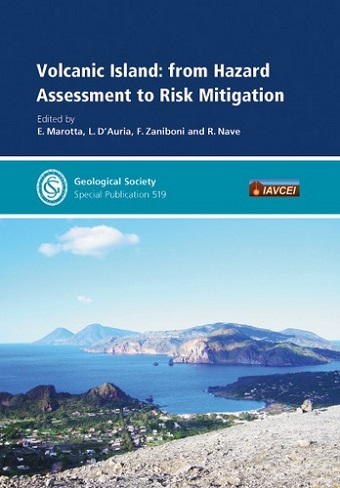
Volcanic Island: from Hazard Assessment to Risk Mitigation
Product code: SP519
Print publication date: 01/01/2024
Geological Society of London, GSL Special Publications, Geohazards, Volcanology
Binding: Hardback
ISBN: 9781786205650
Author/Edited by: Edited by E. Marotta, L. D'Auria, F. Zaniboni and R. Nave
Weight: 0.8kg
Number of pages: 176
Online publication date: 04/01/2024
Lyell Collection URL: https://www.lyellcollection.org/toc/sp/519/1
£100.00
Log in for your member priceFull Description
Special Publication 519
Co-published with IAVCEI
This Special Publication is a contribution from The Cities and Volcanoes Commission of the International Association of Volcanology and Chemistry of the Earth’s Interior. The Commission’s role is to encourage the exchange of experiences on volcanic islands to identify best practice in hazard assessment, monitoring techniques and risk mitigation strategies. The volume contains nine papers from internationally recognized authors that present studies undertaken on Ischia Island and Stromboli in the Mediterranean Sea, Hawaii in the Pacific Ocean, and the Azores in the Atlantic Ocean.
This volume will be of interest to all scientists working in the assessment of volcanic hazard and risk mitigation.
Griffiths, J. S. and Law, R. D. Introduction to SP519 – volcanic islands: from hazard assessment to risk mitigation
Multidisciplinary approaches to understanding volcanic islands
Della Seta, M., Esposito, C., Fiorucci, M., Marmoni, G. M., Martino, S., Sottili, G., Belviso, P., Carandente, A., de Vita, S., Marotta, E. and Peluso, R. Thermal monitoring to infer possible interactions between shallow hydrothermal system and slope-scale gravitational deformation of Mt Epomeo (Ischia Island, Italy)
Marotta, E., Berrino, G., de Vita, S., Di Vito, M. and Camacho, A. G. Structural setting of the Ischia resurgent caldera (southern Tyrrhenian Sea, Italy) by integrated 3D gravity inversion and geological models
Tramelli, A., Orazi, M., Nardone, L., Bobbio, A., Benincasa, A., Buonocunto, C., Capello, M., Caputo, A., Castellano, M., D’Auria, L., De Cesare, W., Di Filippo, A., Galluzzo, D., Gaudiosi, G., Giudicepietro, F., Liguoro, F., Lo Bascio, D., Martini, M., Martino, C., Peluso, R., Ricciolino, P., Scarpato, G., Torello, V. and Bianco, F. The seismic network of Ischia island from 1993 to 2021
Longo, M., Lazzaro, G., Caruso, C. G., Corbo, A., Sciré Scappuzzo, S., Italiano, F., Gattuso, A. and Romano, D. Hydro-acoustic signals from the Panarea shallow hydrothermal field: new inferences of a direct link with Stromboli
Musacchio, M., Silvestri, M., Rabuffi, F., Buongiorno, M. F. and Falcone, S. Kīl̄auea–Leilani 2018 lava flow delineation using Sentinel2 and Landsat8 images
Tsunamis from volcanic environments
Zaniboni, F., Pagnoni, G., Gallotti, G., Tinti, S. and Armigliato, A. Landslide-tsunamis along the flanks of Mount Epomeo, Ischia: propagation patterns and coastal hazard for the Campania Coasts, Italy
Fornaciai, A., Favalli, M. and Nannipieri, L. Reconstruction of the 2002 tsunami at Stromboli using the non-hydrostatic WAVE model (NHWAVE) 1
Volcanoes and society
Lotteri, A., Speake, J., Kennedy, V., Wallenstein, N., Coutinho, R., Chester, D., Duncan, A., Dibben, C. and Ferreira, F. Changing hazard awareness over two decades: the case of Furnas, São Miguel (Azores)
Tomasone, M., Avvisati, G., Cirillo, F., Colucci, O., Marotta, E., Fiorenza, E., Vertechi, E. and Simonetti, B. Risk management planning on a volcanic island: fear and loathing in Ischia (Italy)
Index
Living near active volcanism offers both benefits and profound challenges. Volcanic Island: from Hazard Assessment to Risk Mitigation brings together recent research to explore how these issues can be better understood and managed, particularly in island settings where communities often face heightened vulnerability. The book collates nine research papers that are structured into three thematic sections: Multidisciplinary Approaches to Understanding Volcanic Islands, Tsunamis from Volcanic Environments, and Volcanoes and Society. The volume highlights the importance of integrating geological, geophysical, and social science perspectives to inform hazard assessment and risk reduction. Its editors have balanced technical depth with practical applications, making this book an invaluable resource for practitioners and researchers in volcanology, risk and disaster management, and related fields. The first section emphasises integrating disciplines and methodologies to understand volcanic island systems, with case examples from the Italian islands of Ischia and Stromboli, as well as the Hawaiian volcano Kilauea. The second section delves into the generation and impact of tsunamis caused by volcanic activity, discussing mechanisms such as flank collapse and landslides taking place on the aforementioned islands. The final section addresses the interaction between volcanoes and society, examining community preparedness through emergency planning, public awareness and perceptions of volcanic risks, and effective communication strategies – all brought to life through fascinating case studies, including that of Furnas Village on São Miguel Island, Azores, where the population live within an active caldera. Undoubtedly, it is this section that underscores the importance of involving local communities in risk mitigation efforts and effective policymaking to reduce vulnerability. As expected from a Geological Society of London Special publication, the volume is predominantly aimed at specialists and advanced students, presuming a strong background knowledge in geoscience or related fields. However, the clarity of writing in the chosen articles and comprehensive introductory section from the editors also makes it reasonably accessible for motivated undergraduates. Overall, the book is a valuable resource that successfully bridges theoretical research and real-world applications, offering crucial insights for academics, professionals, policymakers, and students interested in volcanic risk mitigation.
Reviewed by Kane Coxon, Geoscientist, Winter 2025.


