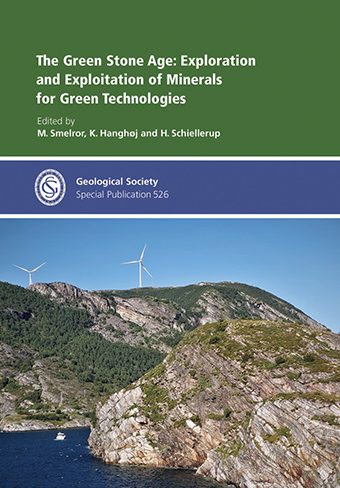
The Green Stone Age: Exploration and Exploitation of Minerals for Green Technologies
Product code: SP526
Print publication date: 21/06/2023
Geological Society of London, GSL Special Publications, Earth Materials Deposits and Petrology, Mineral and ore deposits, Sustainability
Binding: Hardback
ISBN: 9781786205735
Author/Edited by: Edited by M. Smelror, K. Hanghøj, H. Schiellerup
Weight: 0.95kg
Number of pages: 346
Online publication date: 15/06/2023
Lyell Collection URL: https://www.lyellcollection.org/toc/sp/526/1
£100.00
Log in for your member priceFull Description
Special Publication 526
Raw materials have been essential in the development of all human societies through history and moving into a greener, more carbon-lean future we become increasingly reliant on access to a growing number of raw materials. Minerals for new technologies improving the quality of our lives and the environment are the building blocks of the new Green Stone Age. This Special Publication presents ongoing research and mapping programmes focusing on minerals needed for the transformation to greener societies. In addition to new exploration models and shared geological information on the different prospective currently mined areas, the notion of criticality in different countries is discussed and examples of ongoing national and cross-country research and mapping programmes are presented. In addition to the resource/reserve and technical-economic aspects, the social and environmental dimensions are also a focus in some of the contributions, as holistic approaches to the exploration and exploitation of critical minerals and materials are needed to fulfil the green transition and goals for the Green Stone Age.
Introduction
Smelror, M., Hanghøj, K. and Schiellerup, H. Entering the Green Stone Age – introduction
The path to zero: how geology is part of the solution
Watzel, R. Minerals for future technologies: how Germany copes with challenges
Gadd, M. G., Lawley, C. J. M., Corriveau, L., Houlé, M., Peter, J. M., Plouffe, A., Potter, E., Sappin, A.-A., Pilote, J.-L., Marquis, G. and Lebel, D. Public geoscience solutions for diversifying Canada’s critical mineral production
Jørgensen, L. F., Wittenberg, A., Deady, E., Kumelj, Š and Tulstrup, J. European mineral intelligence – collecting, harmonizing and sharing data on European raw materials
Hale, T. N. and Ali, S. H. Afghanistan’s mineral fortune: prospects for fuelling a green transition?
Jonsson, E., Törmänen, T., Keiding, J. K., Bjerkgård, T., Eilu, P., Pokki, J., Gautneb, H., Reginiussen, H., Rosa, D., Sadeghi, M., Sandstad, J. S. and Stendal, H. Critical metals and minerals in the Nordic countries of Europe: diversity of mineralization and green energy potential
Murguía, D. I. and Bastida, A. E. Critical and energy transition minerals in Argentina: mineral potential and challenges for strengthening public institutions
McGrath, E., O’Donnell, E. and Torremans, K. Digging our way to a Just Transition
Exploration for critical minerals
Bidgood, A. and Hitzman, M. New models to aid the discovery of critical raw material deposits for the Green Stone Age
Müller, A., Reimer, W., Wall, F., Williamson, B., Menuge, J., Brönner, M., Haase, C., Brauch, K., Pohl, C., Lima, A., Teodoro, A., Cardoso-Fernandes, J., Roda-Robles, E., Harrop, J., Smith, K., Wanke, D., Unterweissacher, T., Hopfner, M., Schröder, M., Clifford, B., Moutela, P., Lloret, C., Ranza, L. and Rausa, A. GREENPEG – exploration for pegmatite minerals to feed the energy transition: first steps towards the Green Stone Age
Decrée, S., Coint, N., Debaille, V., Hagen-Peter, G., Leduc, T. and Schiellerup, H. The potential for REEs in igneous-related apatite deposits in Europe
Gautneb, H., Rønning, J. S. and Larsen, B. E. A step towards meeting battery raw material demand: the geology and exploration of graphite deposits, examples from northern Norway
Mykhailov, V. A., Hrinchenko, O. V. and Malyuk, B. I. Exploration and mining perspectives of the critical elements for green technologies in Ukraine
Exploration frontiers: seabed mineral deposits
González, F. J., Medialdea, T., Schiellerup, H., Zananiri, I., Ferreira, P., Somoza, L., Monteys, X., Alcorn, T., Marino, E., Lobato, A. B., Zalba-Balda, Íñigo, Kuhn, T., Nyberg, J., Malyuk, B., Magalhães, V., Hein, J. R. and Cherkashov, G. MINDeSEA: exploring seabed mineral deposits in European seas, metallogeny and geological potential for strategic and critical raw materials
Ellefmo, S. L., Aberle, N., Hagspiel, V., Ingulstad, M. and Aasly, K. Marine minerals’ role in future holistic mineral resource management
Index
Reviewed by Rachel Spanton in Geoscientist, 9 April 2025
Global demand for the minerals needed for green technologies, such as solar panels and wind turbines, vastly surpasses that of our current supply. Therefore, diversifying mineral sources and supply chains is paramount to supporting a sustainable future. Recent concerns over dominating players in the supply chain have also fostered a larger interest in critical minerals.
The Green Stone Age addresses these issues by firstly emphasising the role of geology in green technologies, before delving into a diverse range of exploration targets and introducing new developments in exploration data tools. Refreshingly, the drawbacks of mining are not hidden away. Instead, the collated papers actively comment on the environmental, social and governance aspects of mining. They call attention to essential research alongside collaboration from industry and investment from governments. A particular highlight is Hale and Ali (2023), who discuss the mineral fortune of Afghanistan, the history of the region, and the needed next steps for sustainable exploration.
There is a generous focus on European geology, which reflects the editors’ personal region of interest and the boom of critical mineral research in Europe. Despite this, the geology discussed and techniques for exploration will be relevant worldwide, and indeed the discussions also include Canada, Argentina, the Central African Belt and the ocean floor.
I highly recommend this special publication to anyone interested in economic geology and resourcing a sustainable future. The editors have done a fantastic job of compiling a publication that builds upon itself. As such, I advise reading the publication in order. Content-wise, a familiarity with petrology and basic geochemistry is very helpful to digest some of the details, but those without this background should not be deterred. This book is a highly relevant collation of papers, though the nature of a developing sector means it is subject to change. Readers must note that statements on ‘current’ legislation and regulations or government standpoints may soon be outdated. However, the geological fact is unlikely to change and I’m excited to see how this publication inspires further research. It will be a key reference document in the years to come.


